

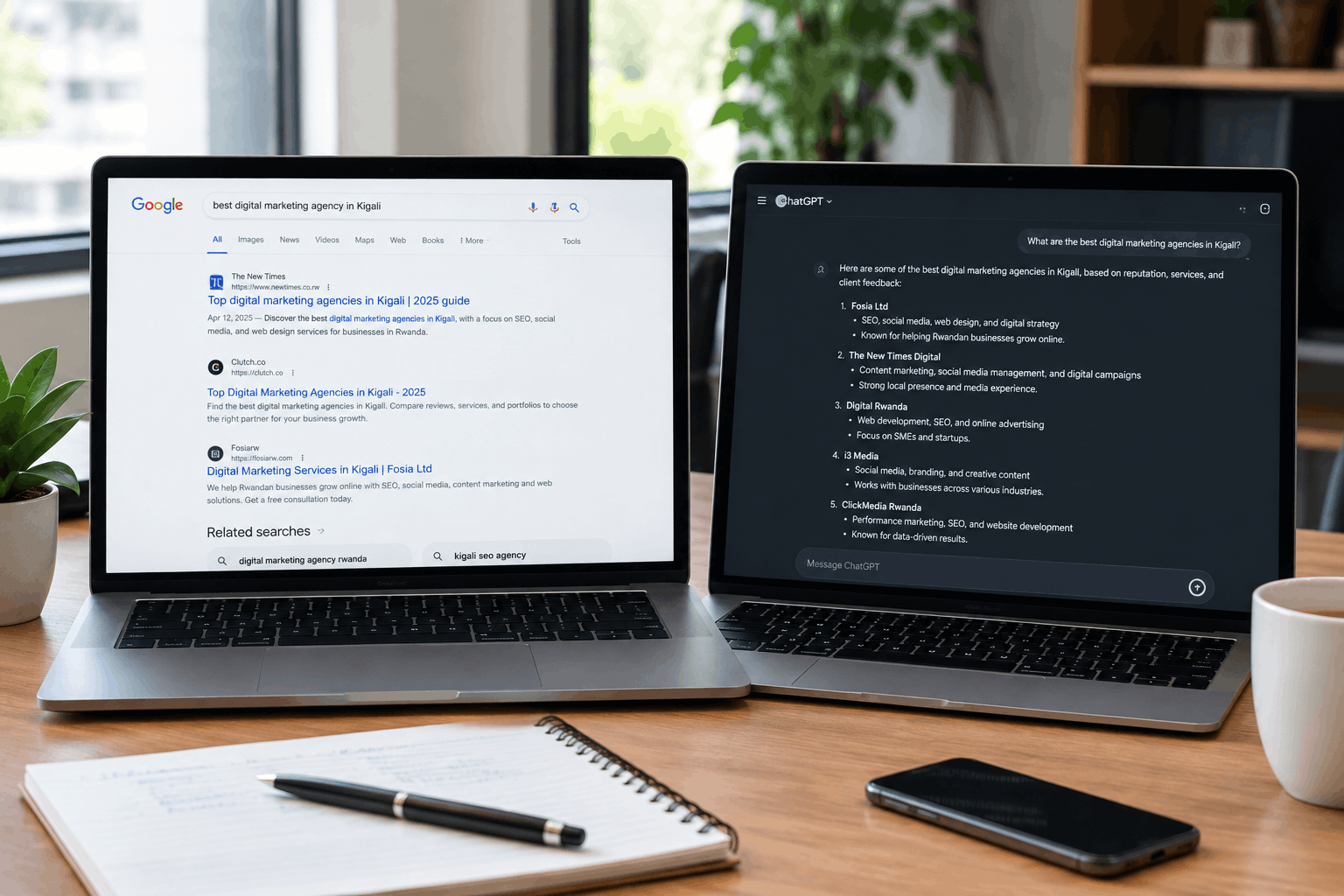
SEO (Search Engine Optimization) and GEO (Generative Engine Optimization) both aim to make content discoverable, but they optimize for different endpoints. SEO targets ranking in traditional search results pages. GEO targets being cited or summarized inside AI-generated answers. They share a common foundation, clear structure, credible sources, relevant keywords, but the tactics that move the needle for each are not identical.
What SEO optimizes for
Classic SEO is built around a list of ranked links. Success is measured by:
- Keyword rankings on a results page
- Click-through rate on a listed link
- Organic traffic that follows a click
- Backlink profile and domain authority
The user still has to click through to a page to get their answer.
What GEO optimizes for
GEO is built around a synthesized answer, often with no list of links at all. Success is measured by:
- Citation rate: how often your brand is mentioned in an AI’s answer to a relevant prompt (full explanation in What Is a Citation Rate?)
- Share of Voice: how your citation frequency compares to named competitors
- Whether the AI’s summary reflects your brand accurately, when it does mention you
Here, the user may never click through at all. The value is being named inside the answer itself, which still drives brand recall and, increasingly, direct traffic when the AI does include a link.
Where the two overlap
Both disciplines reward:
- Clear content structure: descriptive H2/H3 headings, short direct answers near the top of a section
- Structured data: schema markup that explicitly describes what a page or entity is (see our JSON-LD schema guide)
- Authoritative, well-sourced content: pages that cite credible external sources tend to be trusted more, by both search crawlers and AI systems
- Topical depth: thin, generic pages underperform in both search rankings and AI citation likelihood
Where they diverge
| SEO | GEO | |
|---|---|---|
| Primary unit of success | Ranking position | Citation / mention |
| Output the user sees | List of links | Synthesized answer |
| Optimized for | Click-through | Being quoted or named |
| Core artifact | Meta title and description | Self-contained factual statements |
| Measurement tools | Rank trackers, Search Console | AI citation trackers such as AMASO |
A page can rank on page one of Google and still never be cited by ChatGPT, because the phrasing and structure that wins a ranking position isn’t automatically the phrasing an AI model chooses to quote.
Why WordPress sites need both
Traffic sources are fragmenting, not consolidating. A site that only optimizes for classic search rankings is leaving an entire, and growing, discovery channel untouched. On the other hand, a site that only chases AI citations while ignoring basic technical SEO, things like site speed, indexability, mobile usability, undermines the very crawlability that lets AI engines find it in the first place. See what to look for in an AI visibility tool for how to evaluate whether a solution covers both.
FAQ
Do I need separate content for SEO and GEO? Usually not entirely separate content. The same page can serve both goals if it’s structured with clear question-based headings and direct answers, which benefits ranking snippets and AI citation alike.
Which one should a new WordPress site prioritize first? Foundational technical SEO (crawlability, site speed, indexability) should come first, since AI engines still rely on the same crawling infrastructure to discover content. GEO-specific structuring (FAQ schema, llms.txt, direct-answer formatting) layers on top once that foundation is solid.
Can a tool track both SEO rankings and AI citations at once? Some tools specialize in one or the other. AMASO focuses specifically on the AI visibility side, tracking citation rate, Share of Voice and query-level evidence across ChatGPT, Perplexity, Gemini and Claude, designed to sit alongside a traditional SEO tool rather than replace it.
0 Comments